
‘The Tea Cup Set’ by Aditi Purwar is a comic that talks about gender roles and property laws and everyday politics of a family through mundane objects such as a tea cup set in a family of five
5
5
5
.
In our class ‘Decolonial and Postcolonial Art’ with Prof. Jeebesh, the discussion centred around the politics of inheritance. More specifically, the fear surrounding the potential breakage of inheritance—a tension between desires and limits/prohibitions. What follows is a compilation of class notes, discussions, and responses, all woven together through Aditi Purwar’s comic in Hekh Call #1.
I will be referring to essays from Hasvini, Avril, Nora, Arya and class notes from Rishita, Manya and Nora.
Fear is a recurrent theme in the comic, as seen in the daughters’ hesitation to use the new teacups they bought from Agra, or the father’s concern that his daughters might not receive their rightful share of property, as brothers often deny sisters their inheritance.
Fear is not only a reaction here, but a s t ru ct u r e: it ‘causes us to turn to religion, philosophy, and science’ in search of shelter. In fact, it is these very shelters that recreate the fear, trapping us in a paradox. Fear enforces itself recursively, normalizing its presence, invisibly pushing and pulling—‘desire urging us forward, fear pulling us back’—a movement that ultimately cancels itself out, making it seem as if neither the push nor the pull ever existed.
(quotes from Hasvini’s essay)
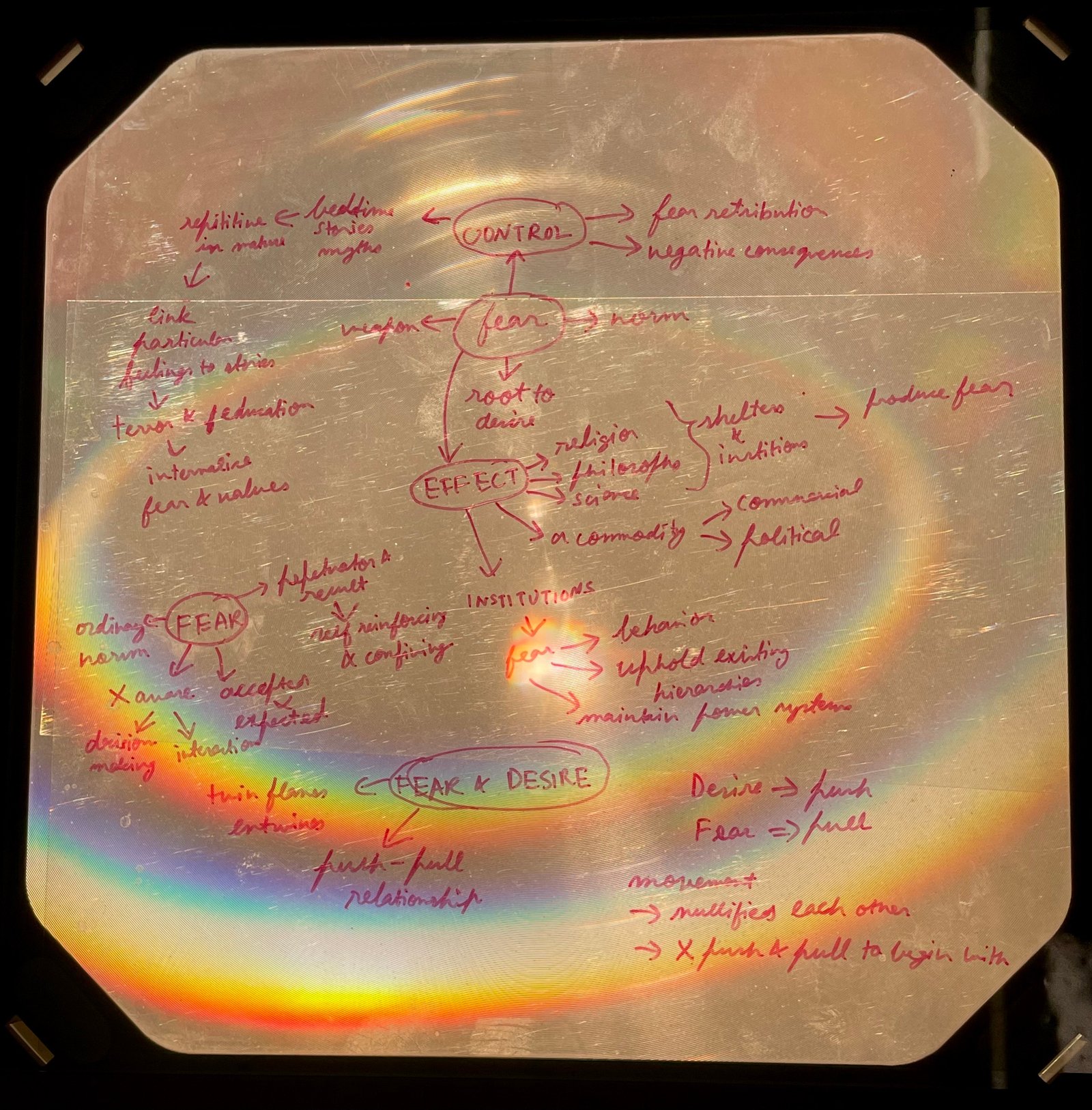 Hasvini's essay in a diagram
‘Society draws lines you are asked to walk without straying. Straying frays the edges of the silken fabric of society- woven with the care of years of fear.’. Milk becomes a metaphor here: pure milk, symbolizing inheritance and privilege, is ‘reserved’ for the ‘protectors’—the men—while watered-down milk, served as tea, is for those deemed a threat, the women. Milk is associated with purity, nourishment and sustenance, provided to the worthy of the patriarchal system, also offered to deities in Hinduism. This milk is given to men as protectors of lineage, while women receive symbolic, rather than substantive, assets.
‘Spilt milk equals rebellion, nuisance, havoc, uncertainty’, for spilled milk within this world (Aditi’s comic’) can be seen as an act of rebellion and disruption. Avril brings forth spilt milk’s associations with bad omens and recalls contemporary protests like the one on Pune-Bengaluru Highway where milk was spilled from the tankers as a mark of protest demanding price increase. Even during the White Revolution (a symbol for national pride and self-sufficiency), women played critical roles in sustaining dairy economies, they were still excluded from the ownership of resources and any economic benefit.
(quotes and ideas from Avril’s essay)
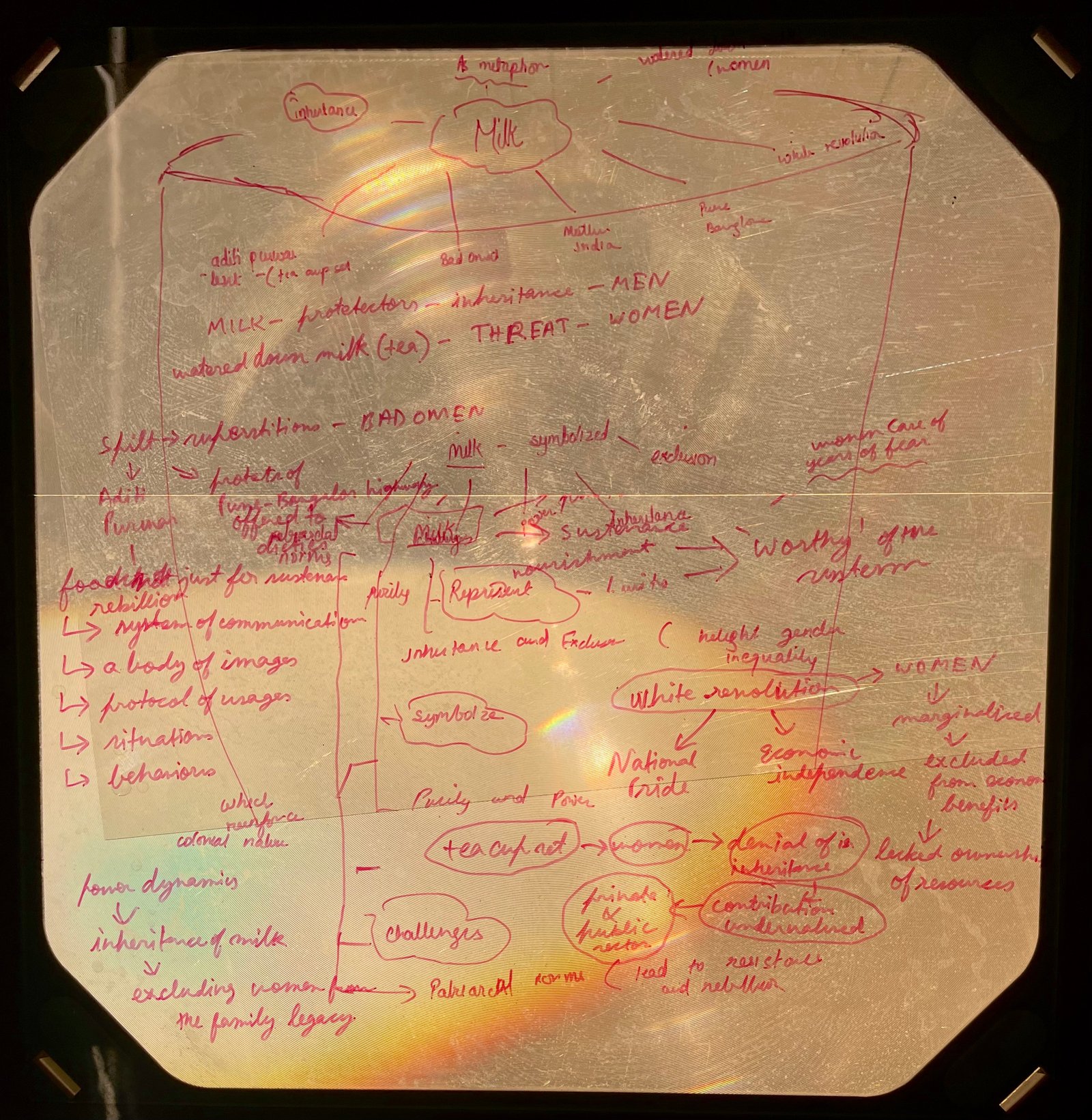 Avril's essay in a diagram
When talking about inheritance, Nora brought up an important point: men and women perceive inheritance differently. For men, inheritance is often a default, a given; for women, it is a security—a home, jewelry, recognition, a tangible belonging—something that must be fought for. The move between the ‘act of securing’ and getting it by ‘default’ is where the struggle is. It is an i n - b e t w e e n state where the ‘navigation is like quicksand’. In a world fractured by caste, class, religion, and gender, no position is truly secure, every attempt at security is itself precarious.
(quotes from Nora’s essay)
a c t o f s e c u r i n g
d e f a u l t
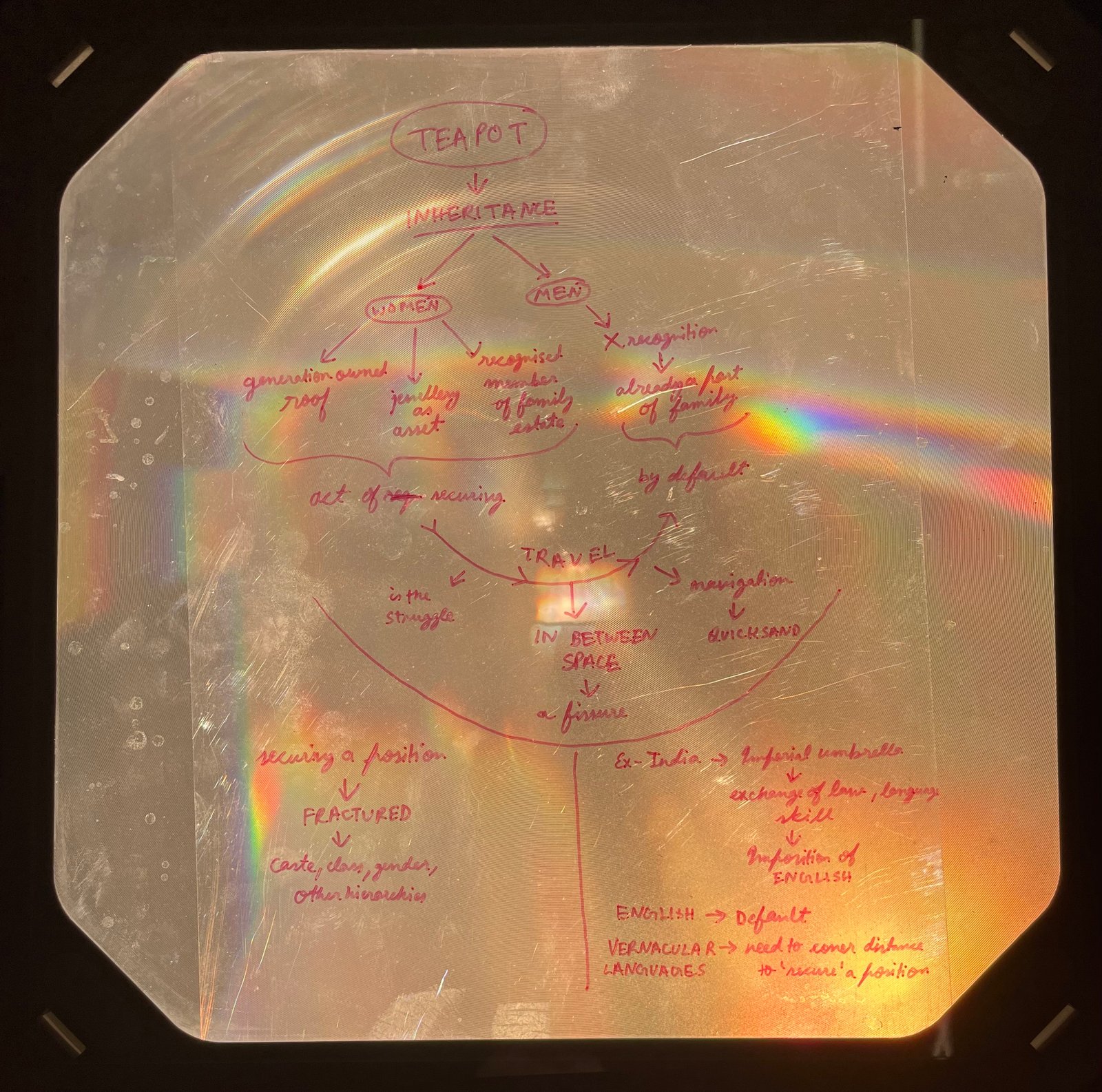 Nora's essay in a diagram
Blood, like milk, becomes another powerful symbol of inheritance. Building on Avril’s idea, Arya drew from The Tragedy of Macbeth, where Lady Macbeth’s invocation—"Take my milk for gall"—marks the transformation of the feminine, nurturing, feeding, pure, white milk into murderous blood.‘Blood that B
L
E
E
D
S, to bleed without a cut is only a feminine gift.’ ‘Without a cut, her hands are now bloodied.’ It is a blood that only she sees, a stain that cannot be washed away. Generational inheritance is not only about tangible assets but also about invisible burdens.
(quotes from Arya’s essay)
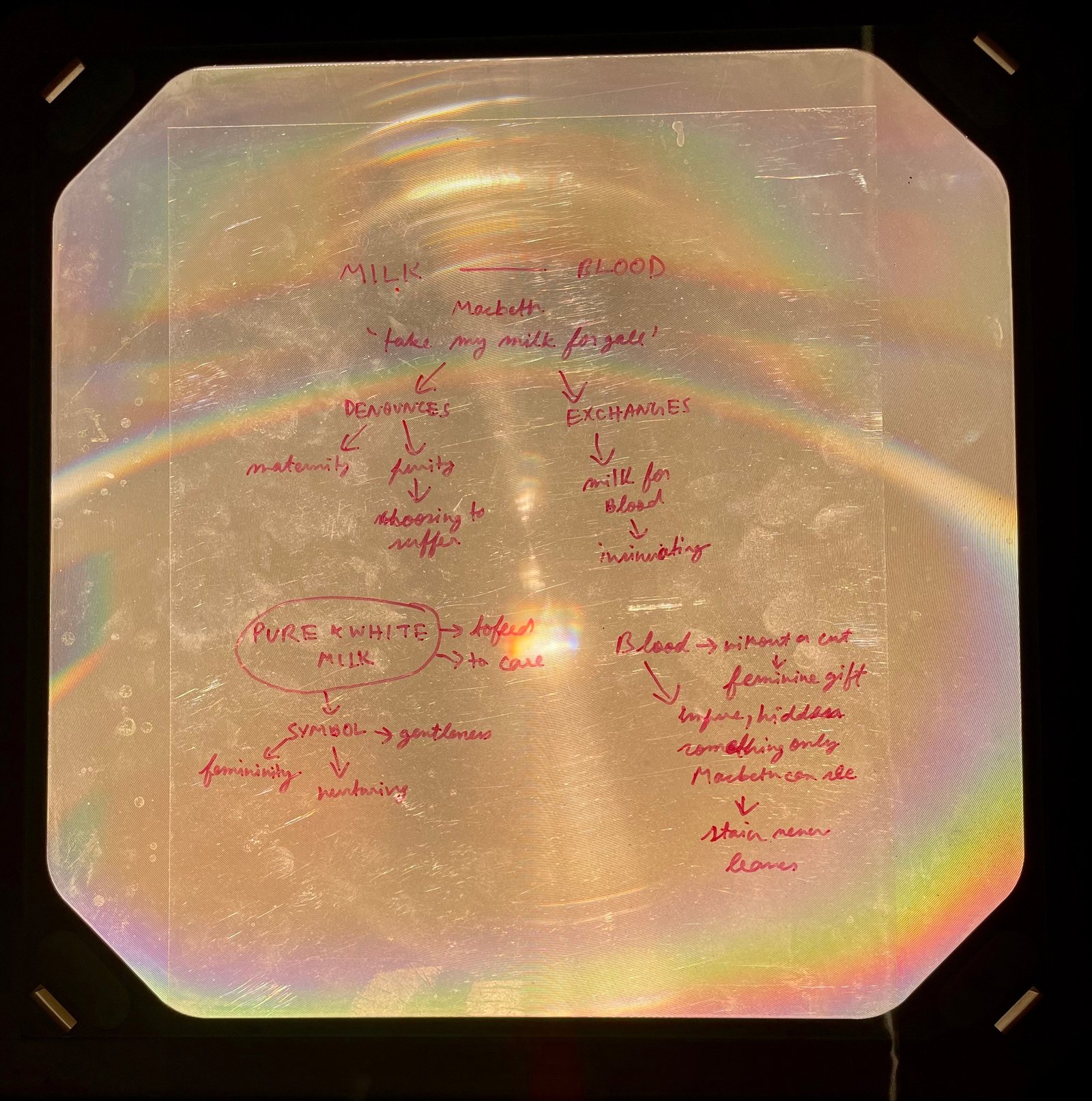 Arya's essay in a diagram
Gender is introduced to the tea pot itself: the teapot, gendered as female, must be handled with care. Rishita responds to the tea cup set by a story. A story where the teapot is filled with precious knowledge, which could poison men if women consumed it in excess. The men safeguarded this knowledge as a privilege reserved only for them as they feared that access to knowledge would empower them to challenge the male authority.
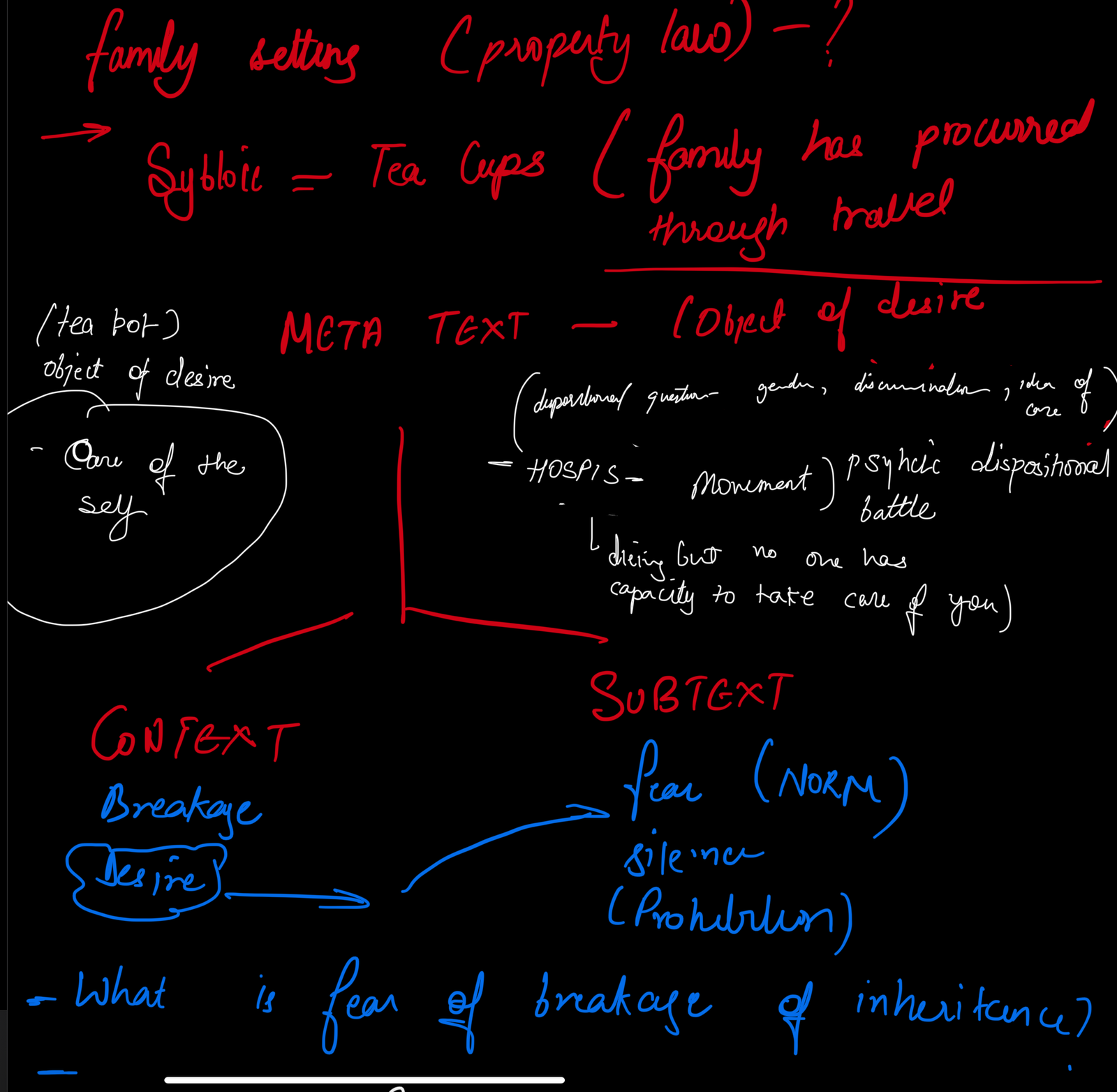
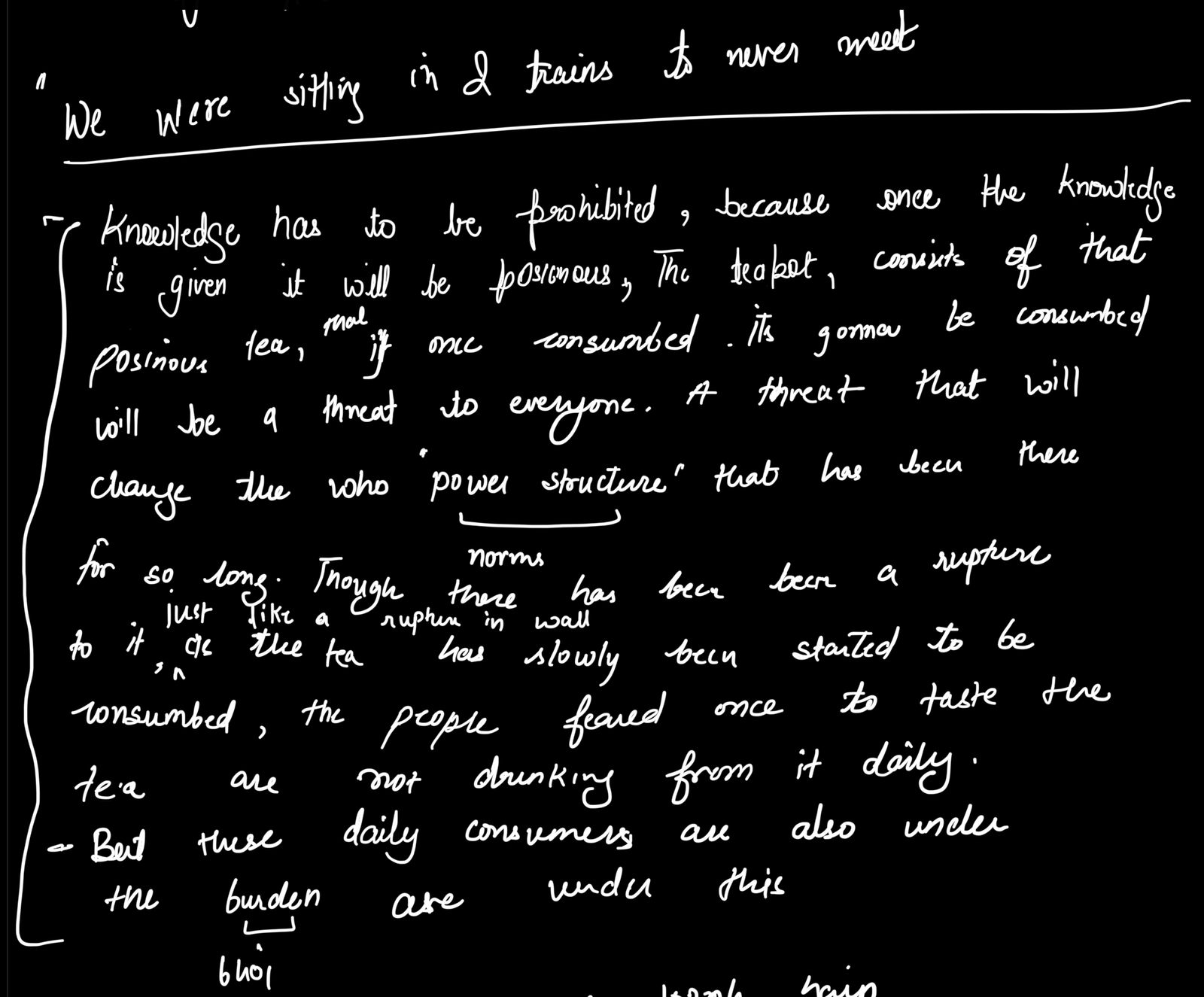 Rishita's class notes and reflections
The larger discussion came to how before we even step in the world the world is already ‘stepped in’ for us. We inherit not only property but the structures of fear, prohibition and silence—what
is
the
nature
of
voice
when
there
is
no
voice? How does one speak within systems designed to mute? There is a tension between the scholastic, the voices of women found in ancient Vedic texts, and the legal, contemporary struggles for women's rights through law. Inheritance shifts shape between these two debates, much like the teapot itself, changing form with each successive legal move, yet never fully breaking free of its original constraints.
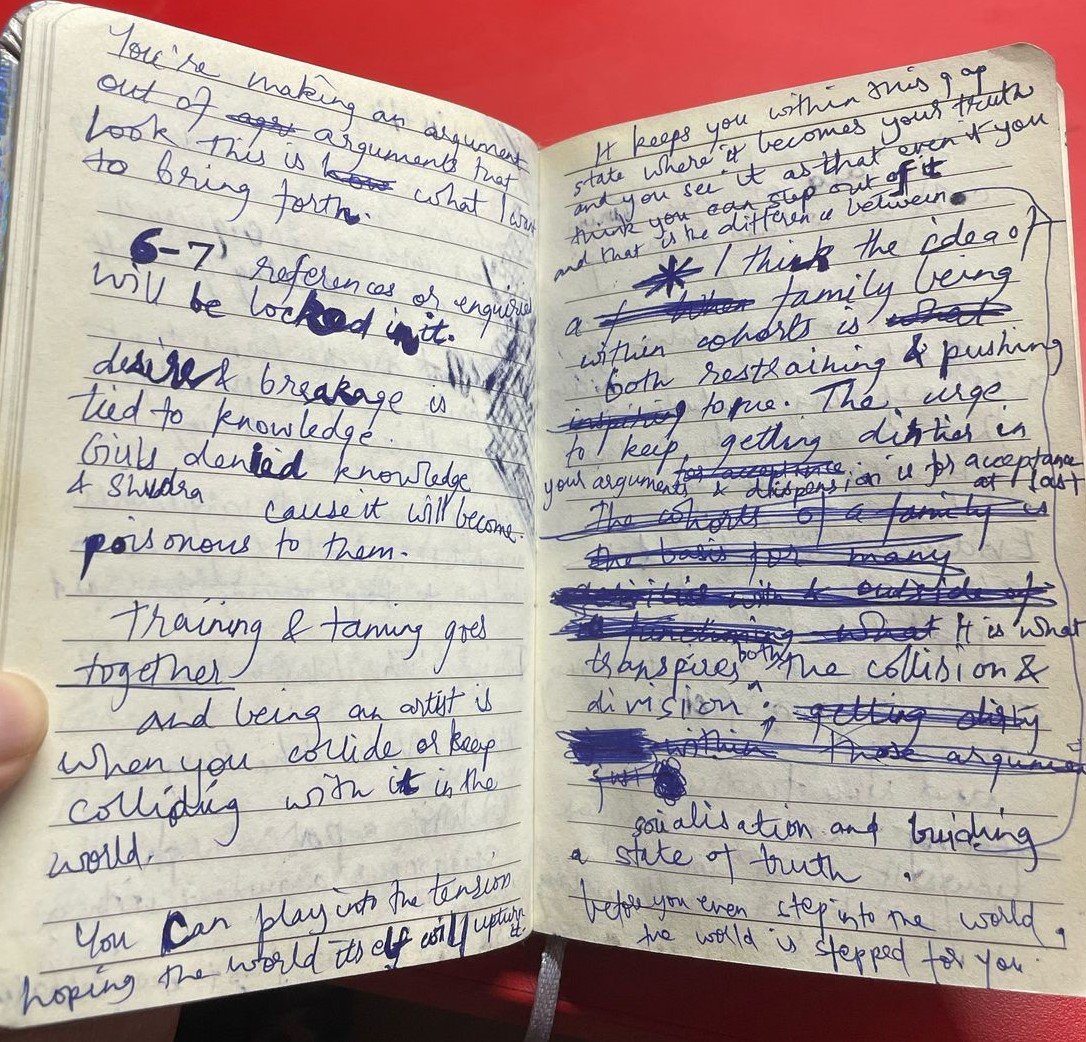
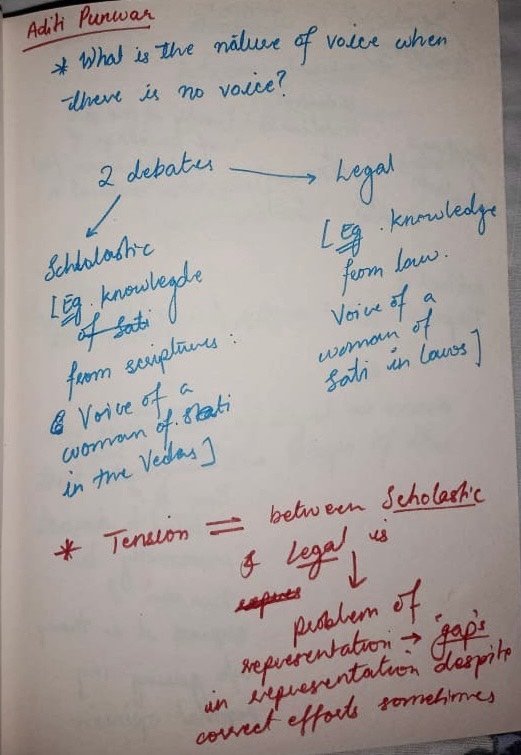
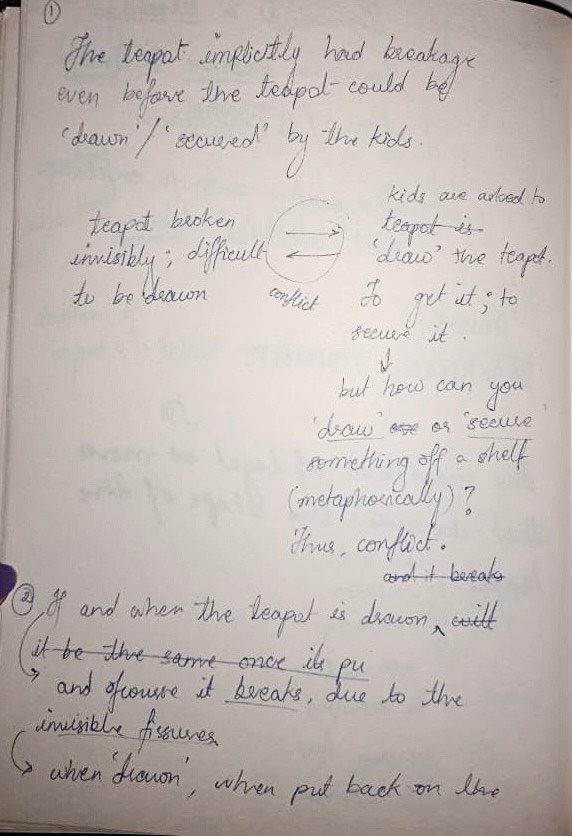 Nora's class notes
Ultimately, ‘The Tea Cup Set’ reveals how the everyday—a mundane tea set—holds within it the complex, often painful, histories of fear, gender, and inheritance that continue to shape lives across generations.
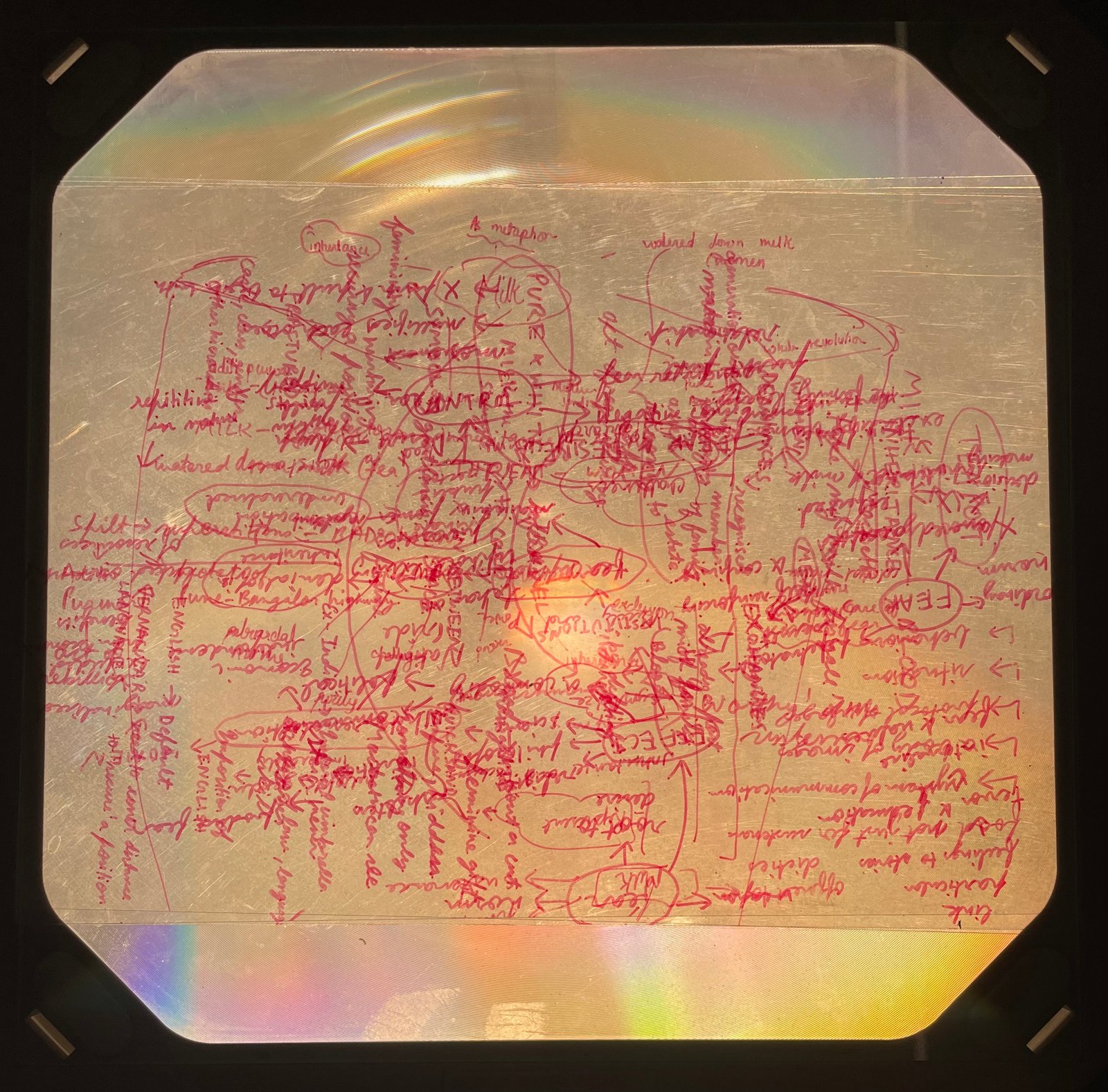 Meta- map
Edited/compiled by
Gunnica Arya
Acknowledgements
Avril Dias
Aditi Purwar
Nora Varma
Sana Gupta
Hasvini Jain
Arjun Verma
Nishtha Jain
Rishita Kohli
Sabar Saluja
Manya Kumar
Arya Sarvanan
Sabaah Babbar
Jeebesh B.
Priyesh Gothwal