
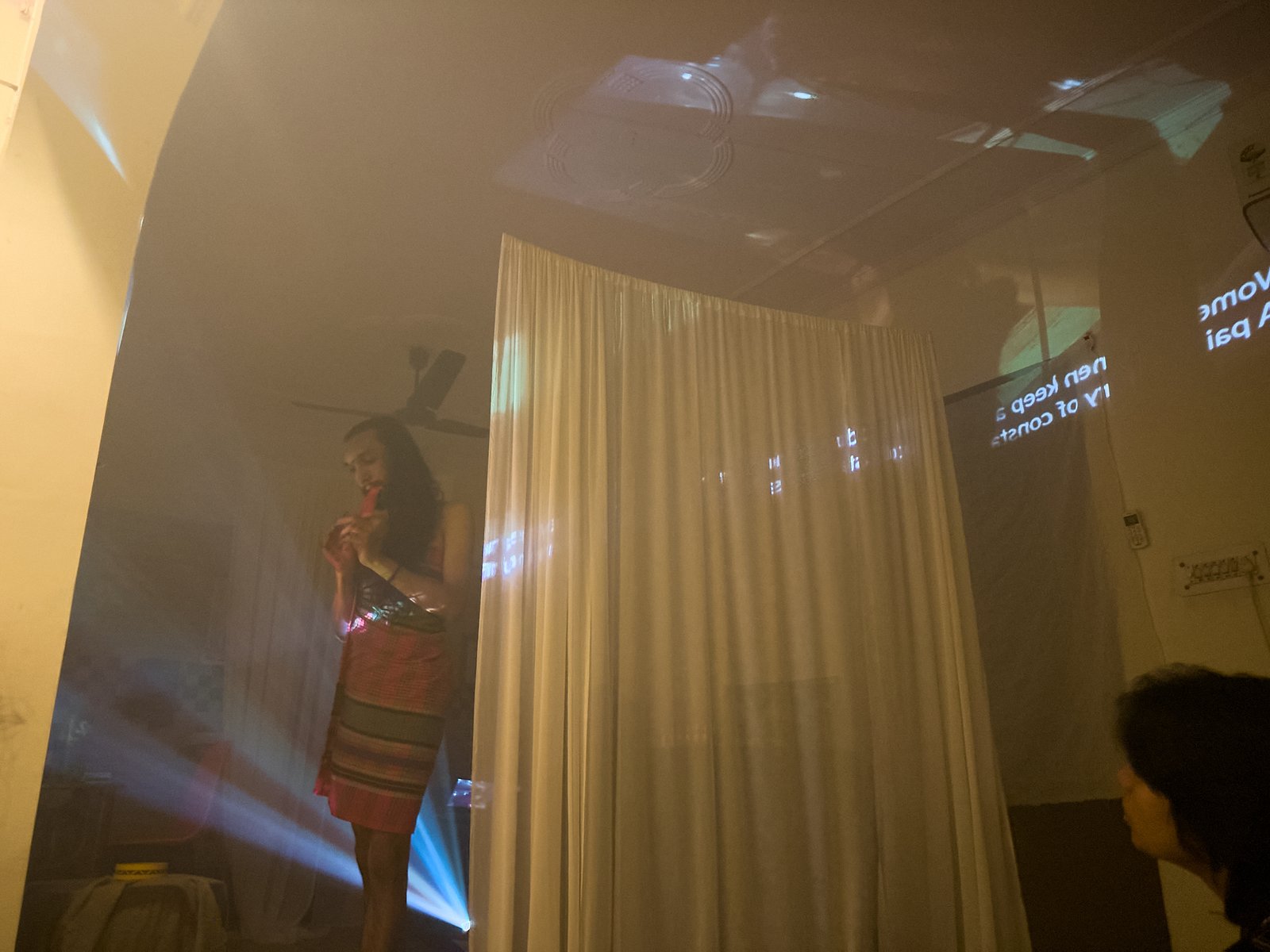
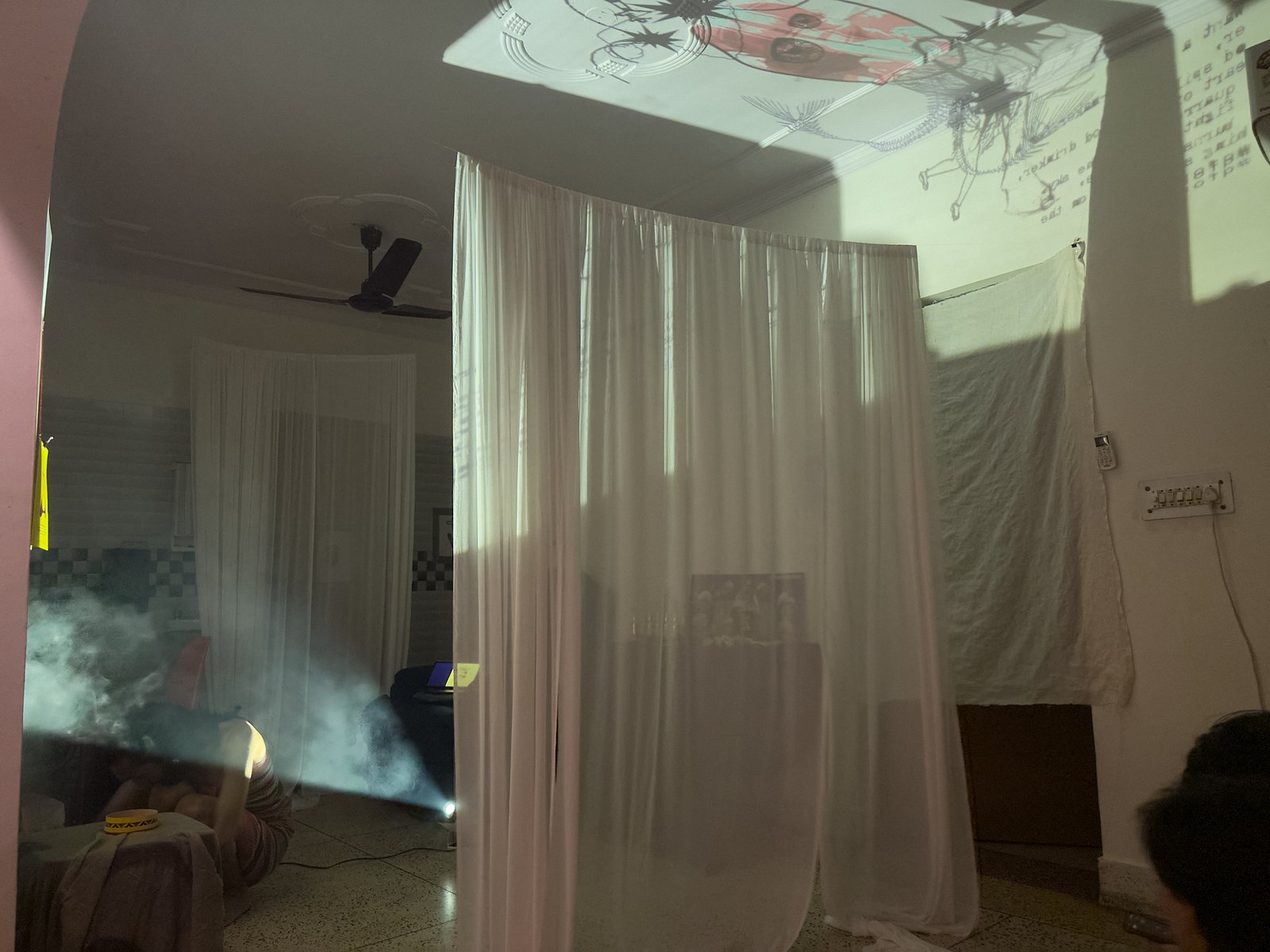
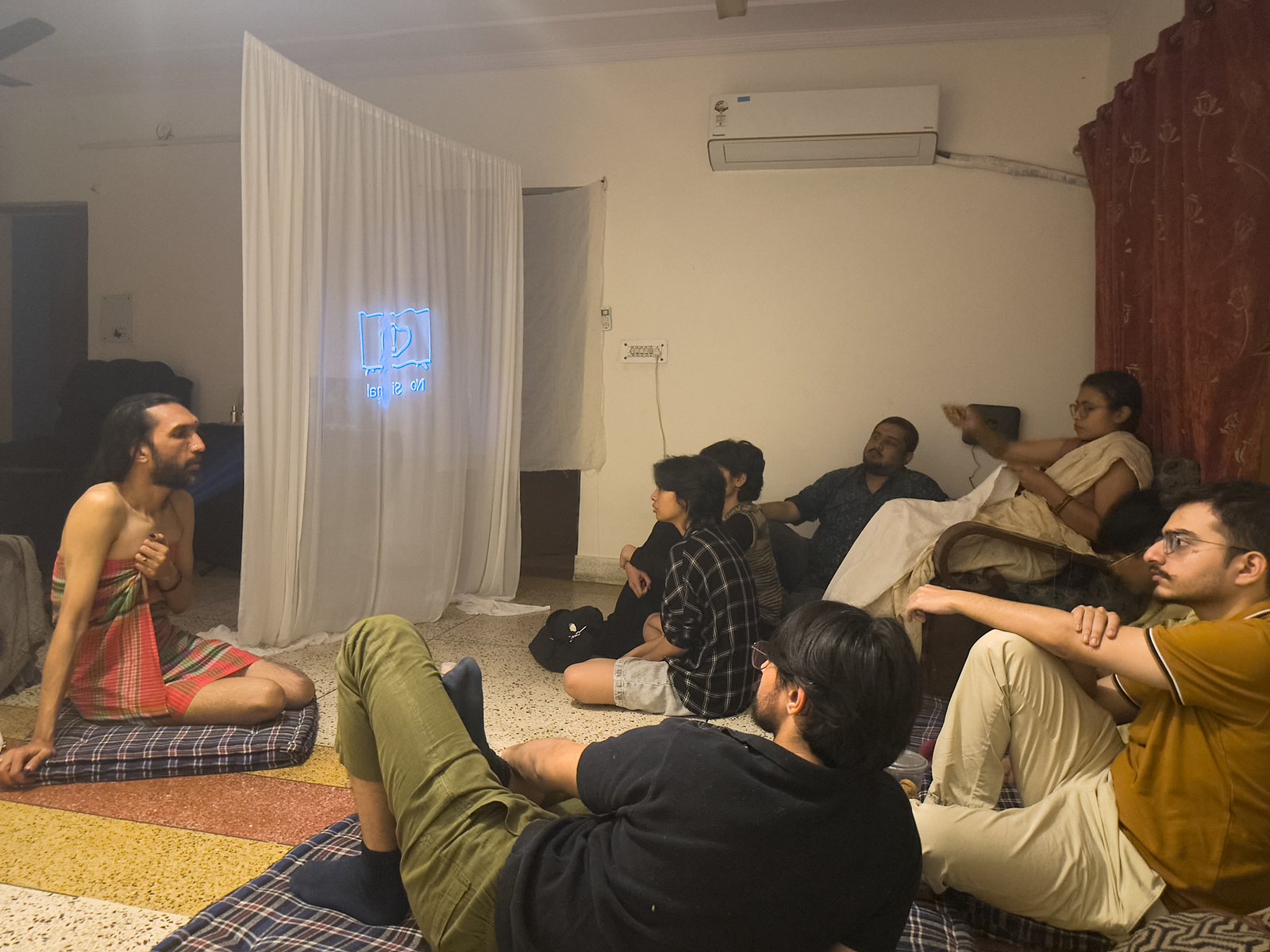
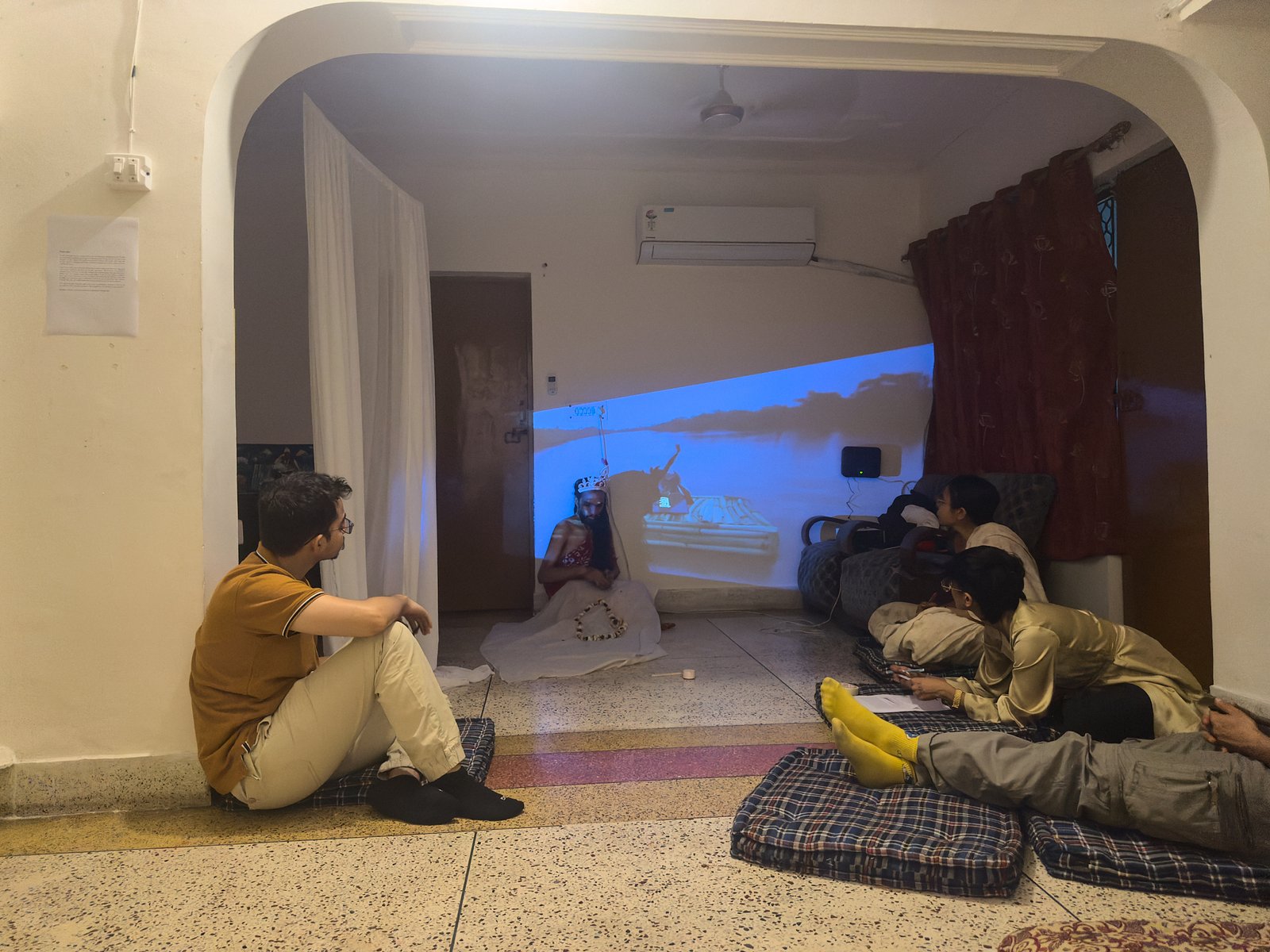
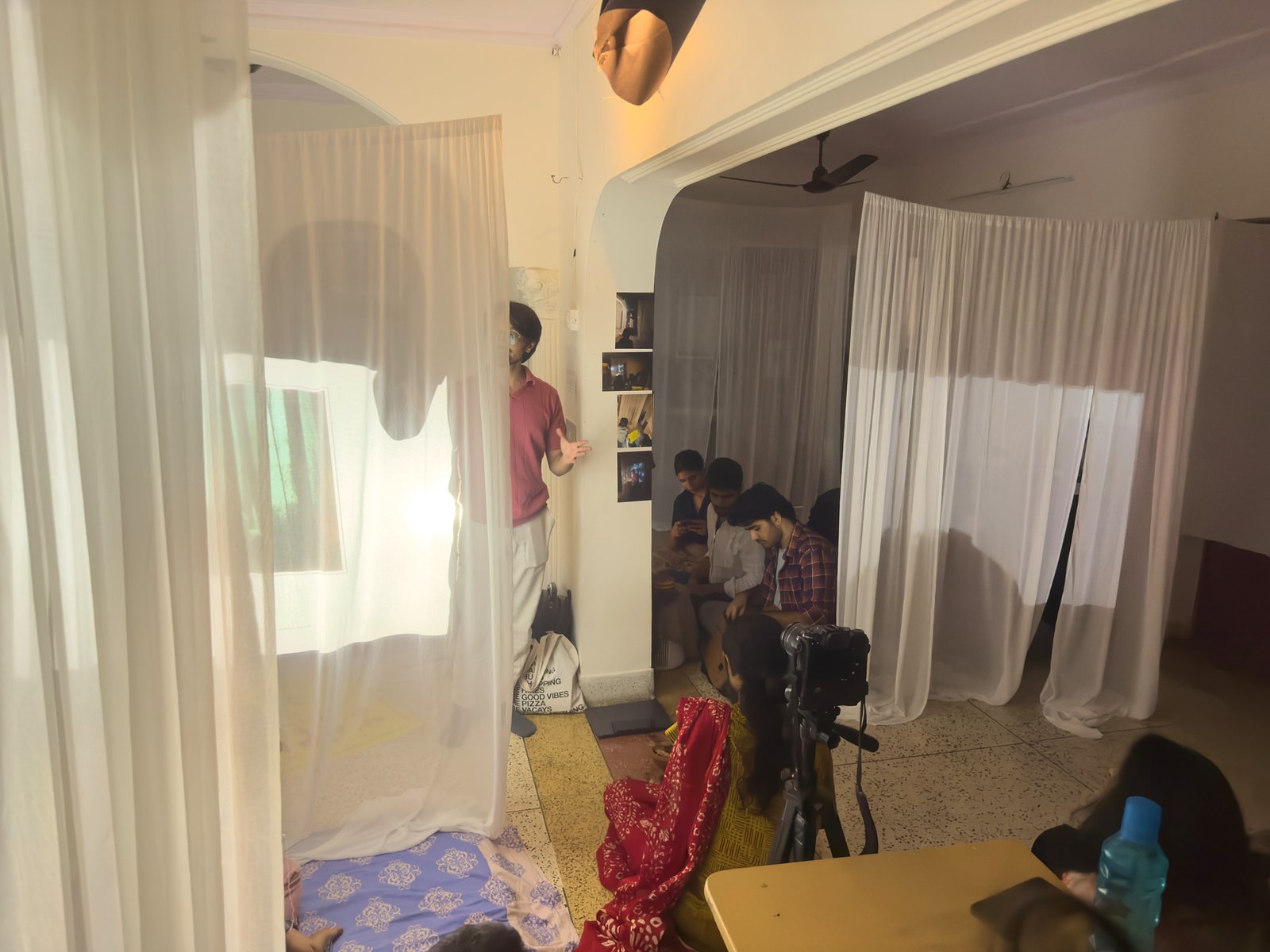
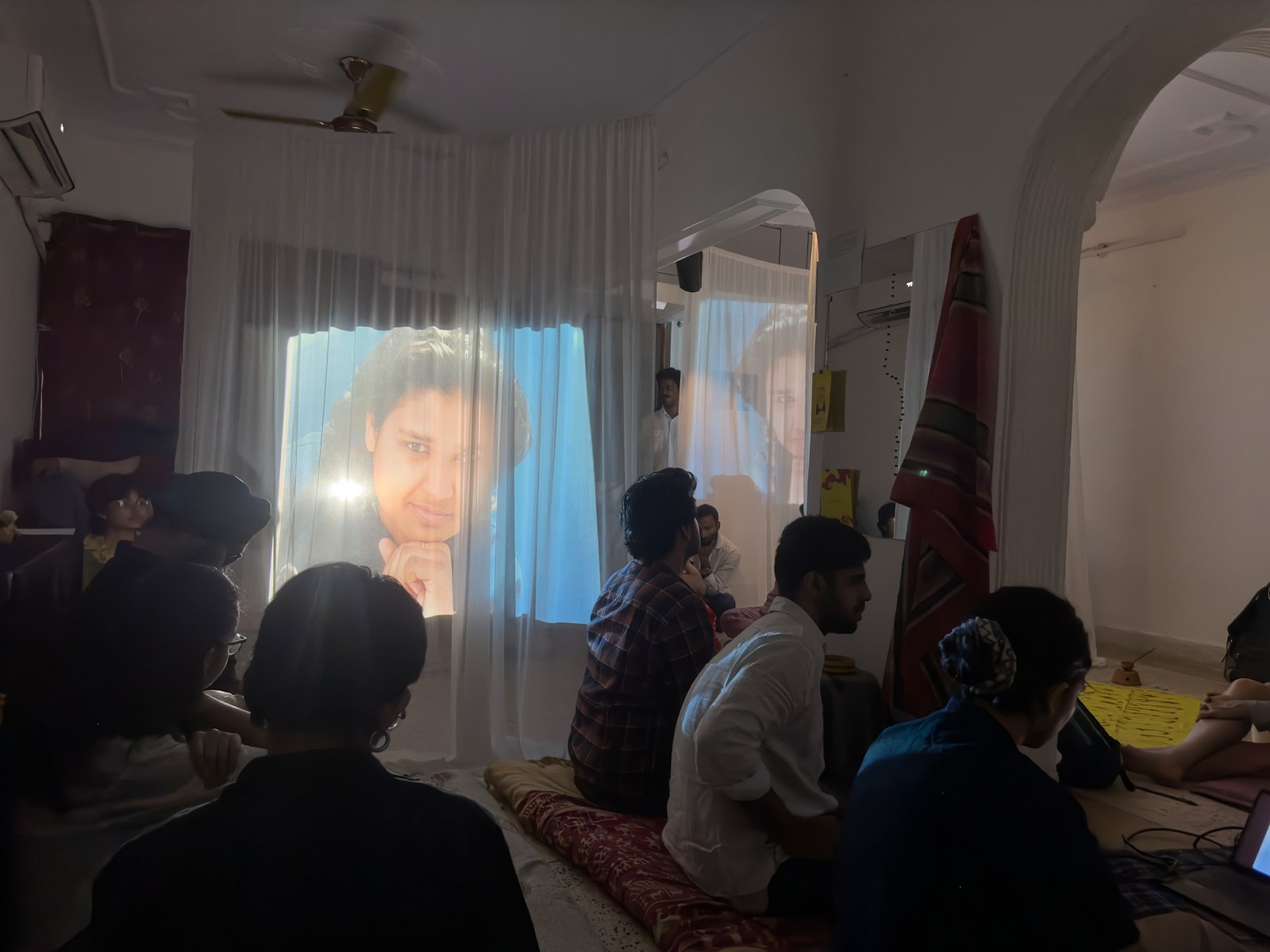
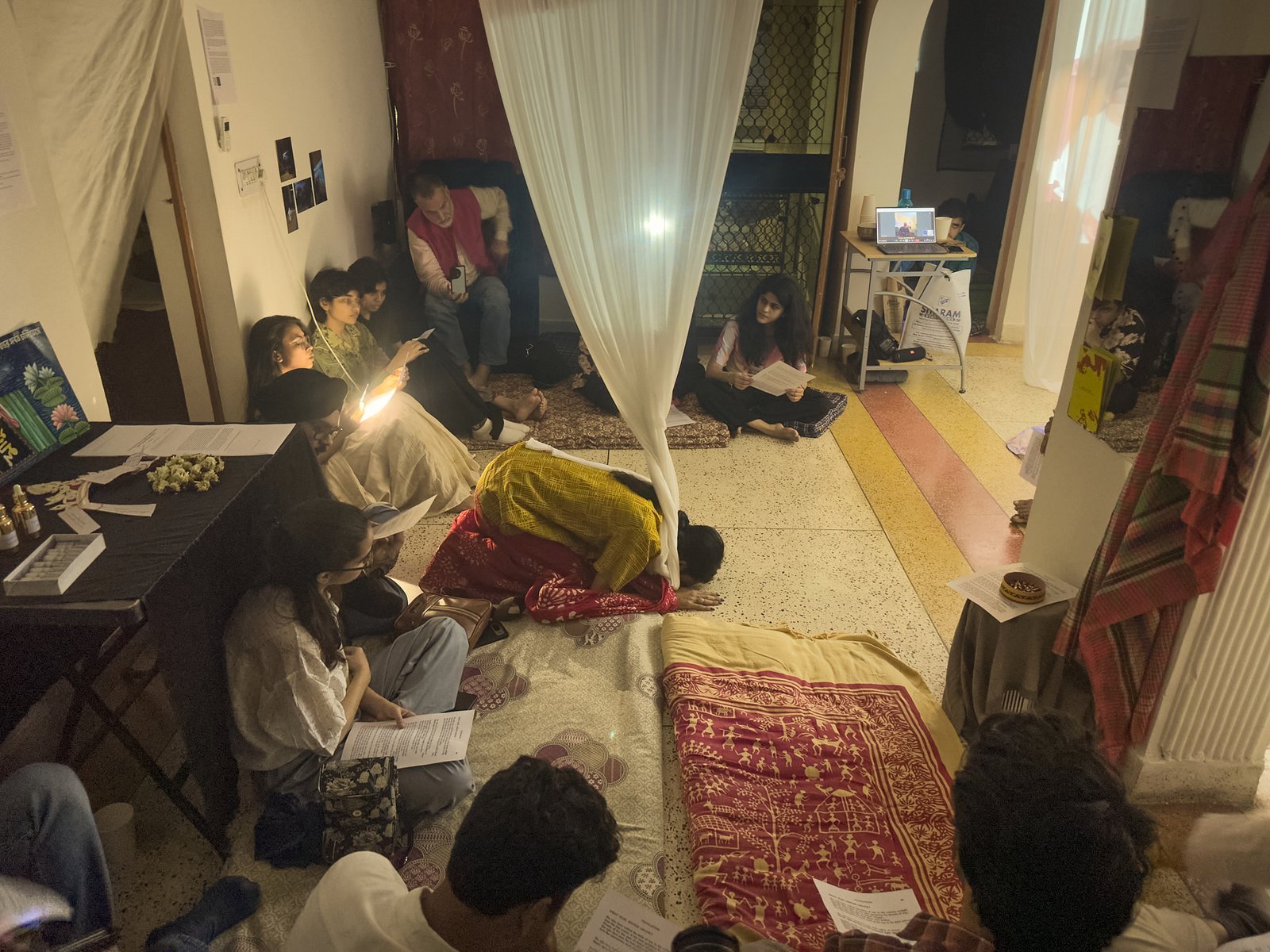
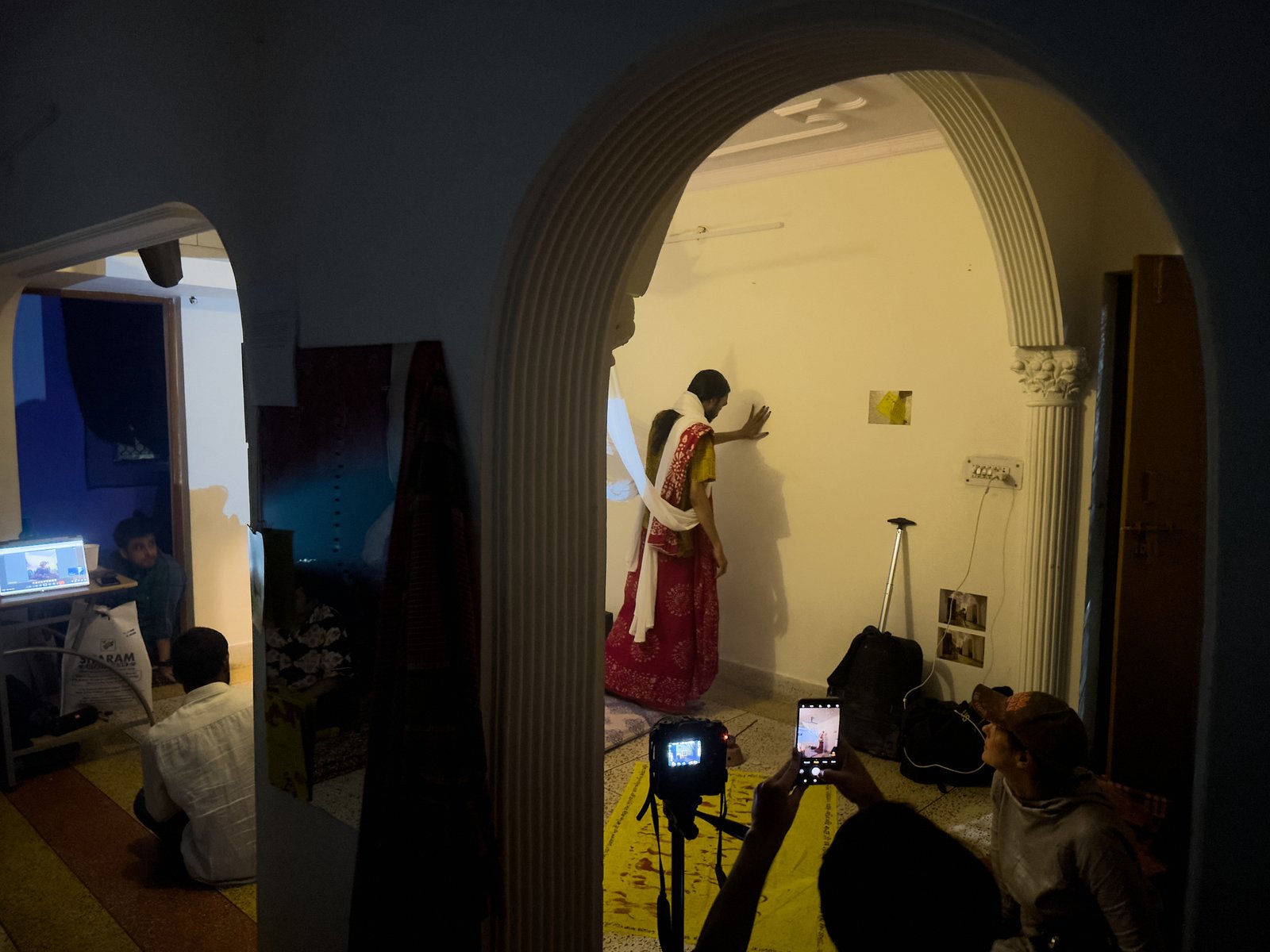
Veil/ing, a collaboration between A South Asian Queer Pamphlet, Queer Childhoods and Hekh, happened on the 15th and 16th of April 2025; thinking of the veil as an object and veiling as a gesture through its material, social, political and cultural registers. The two days involved being in ritual with Kaur Chimuk, A photographic performance by Queer Childhoods (Mayank Agarwal), as well as an unfurling by Rahul Juneja.
Day 1- In ritual with Kaur Chimuk
Positionality
Since I can recall, there has always been a constant dilemma—whose body is this? It might sound spiritual, philosophical, or even provocative, but at the age of 9 or 10, it was a real struggle, though I lacked the words to articulate it during that phrase. Over time, this struggle became entangled with other obstacles—appearance, choices, mannerisms—an unavoidable binary. I feel for my folks; they must have felt the same. What is wrong with this ‘boy’?—absorbing that energy, I recall one evening in an intense conversation with Kumkum. They asked if I wanted to be a womxn or if my body desired to be something else. That question kind of offered me - first notation around my qurious dialect. It was an inner calling—I realized I didn’t want to be a womxn or a man. I wanted to be everything and nothing, if that were possible. I am infinite and fluid. I might return—not as me, but as you or they—but I refuse to be bound by a tag. I am comfortable embracing my presence as a transbinary persona. This ritual has been exercised many times, often unconsciously. However, in 2022-23, we recorded one such exercise and turned it into a signifier for a South Asian queer pamphlet. Location: Varanasi, somewhere between Bangalitola and Mangal Ghat.
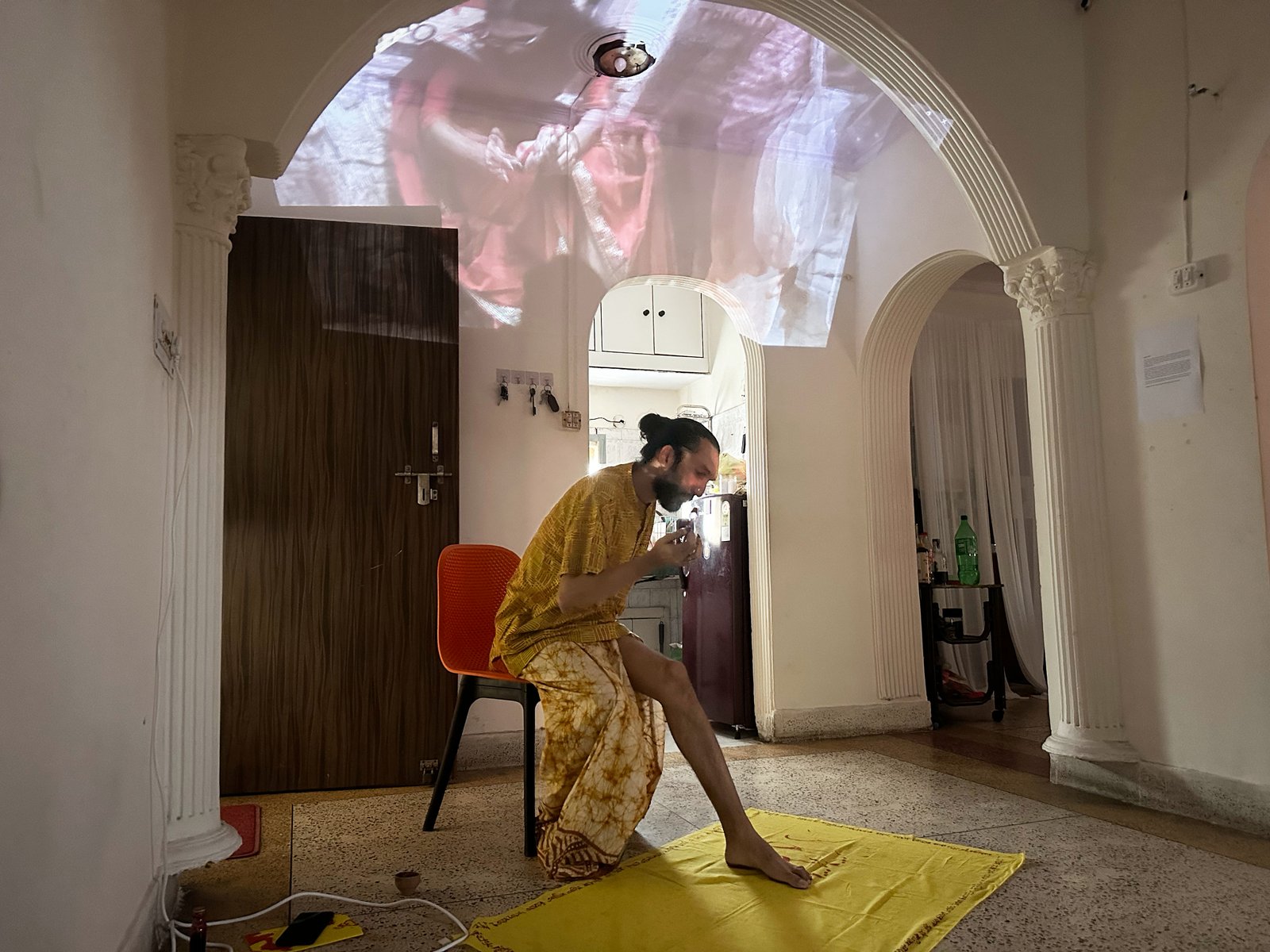
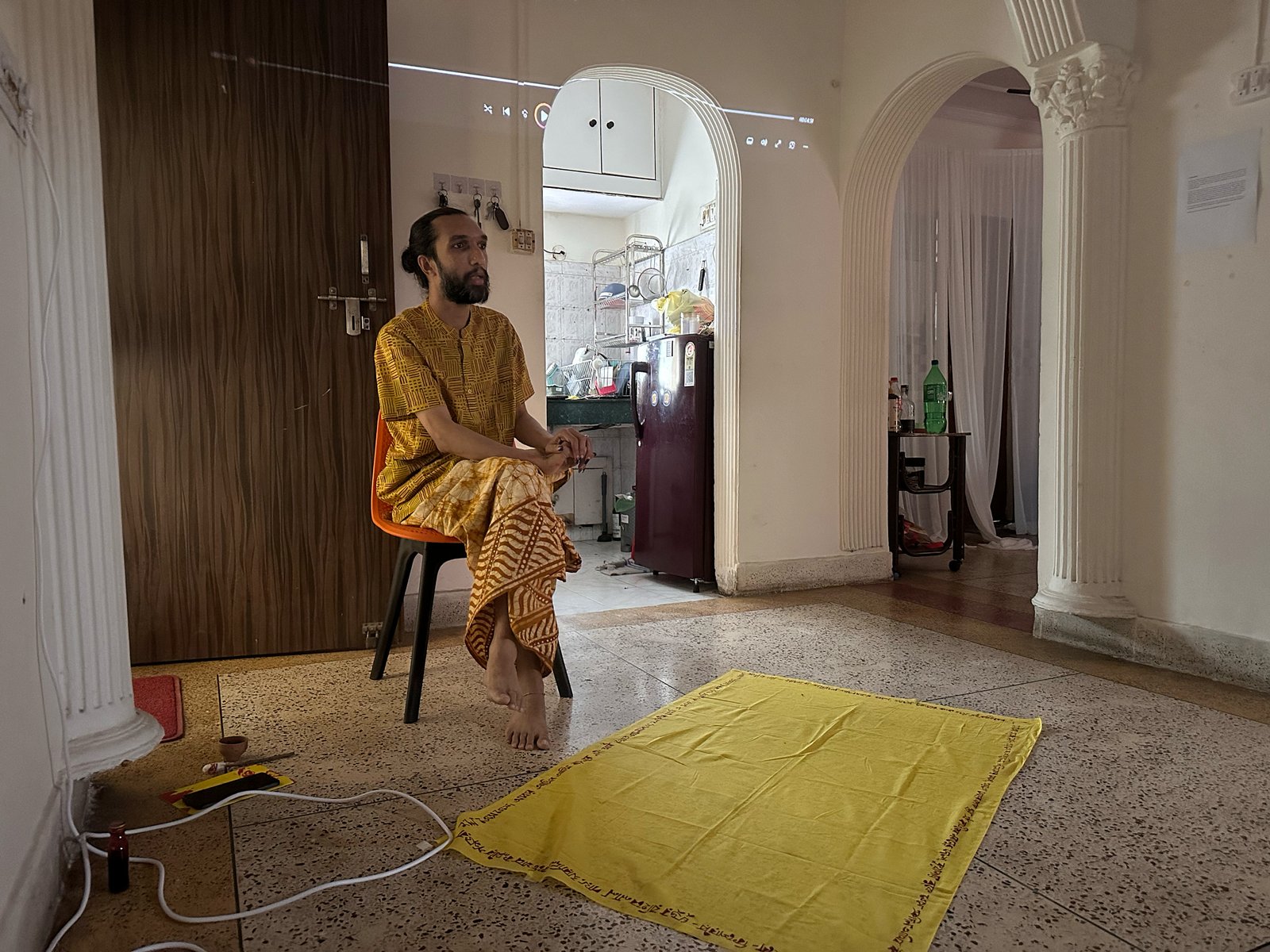
Appearance
I no longer attempt to reconnect with the prolonged violence a body absorbs. It took years to accept that self-care is real—that it is not selfish. The performativity of unlearning has helped me reimagine my body, not as an archival sheet but as an unnoticed napkin—one that continuously soaks in the timelessness of a body in transit. I have carried this poem with me for a while, a monologue that holds and expresses how this body refuses a linear shape. Revisiting this ritual reminds me of my early days when I would hide my bindi as I neared my native town—not out of fear, but due to an unknown anxiety tied to the burden of a normative family structure embedded in my consciousness. Wearing multiple bindis/tips now feels like reclaiming strength from an untraced amnesia. This ritual has been exercised many times, often unconsciously. However, in 2022-23, we recorded one such exercise and turned it into a signifier for a South Asian queer pamphlet. Location: Varanasi, from a boat, sailing near Harishchandra Ghat—the burning station.
Materiality
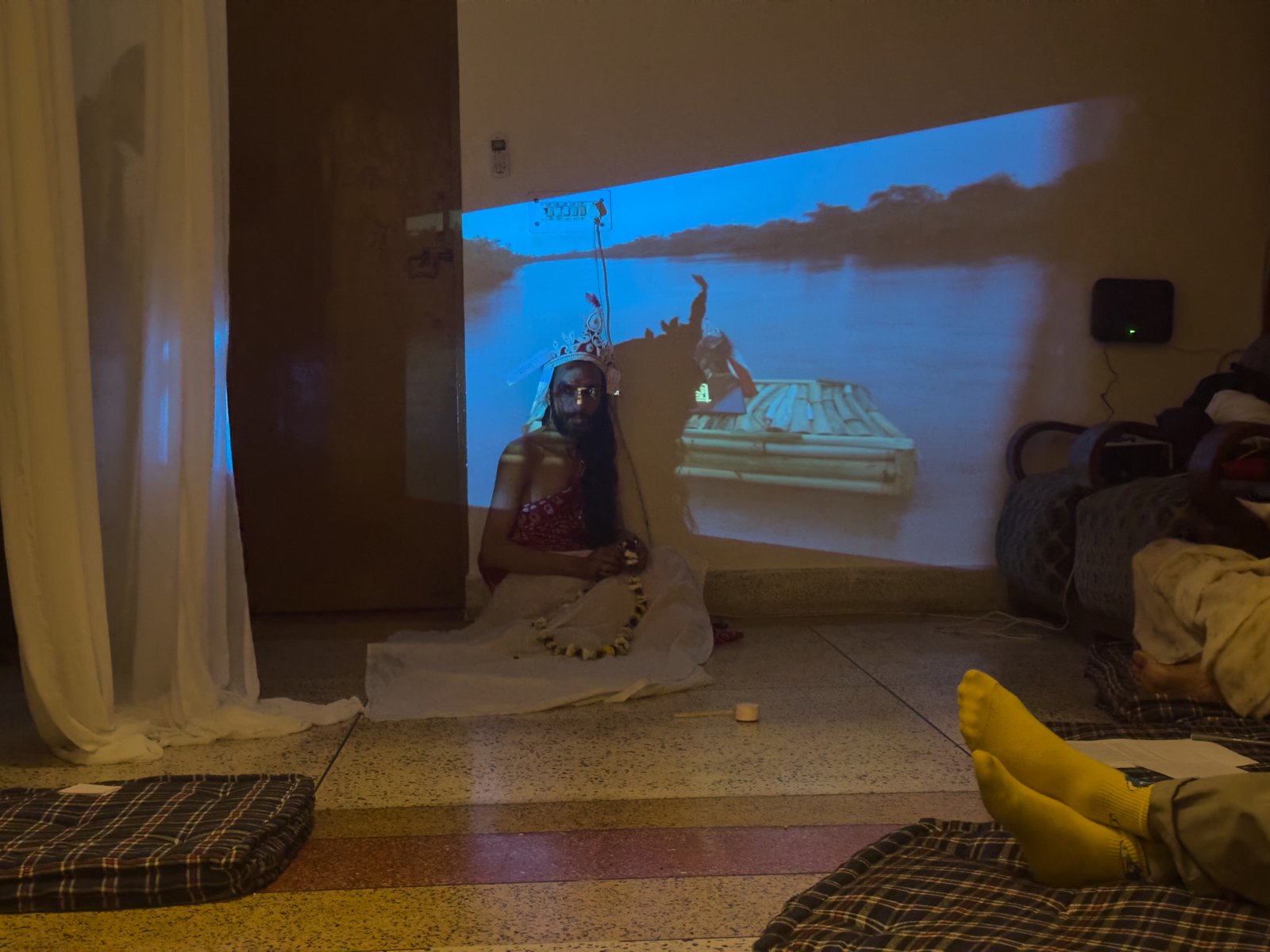
I have vague memories of my grandparents and folx sharing folklore as part of everyday rituals, especially during lullabies. I always questioned (myself)—why do only men and women occupy the center of these narratives, where are we, us and them? My first memories with trans bodies remain special. They would meet me at the local market while I returned from school. Me and my baba—they used to shower me with love for no reason. Sometimes my father offered them something (though that is not the important part) as an extended care. Their presence, their harmonies—they inspired me as a child. Later, when I first heard the story of Behula—a long-standing local folklore, a mystical cultural notation that binds unpartitioned Bengal—I felt a part of myself within that story. Many years later, during my university days, when someone introduced me with Chand Baniker Pala by Shambhu Mitra’s - this interpretation kind of blew my mind, I realized it was more than just literature. It was a signal—one that held multiple queer perspectives. Revisiting this ritual was one of the most difficult engagements I have had, more than I could have predicted. Yet, it allowed me to understand things beyond my anticipation. This ritual has been exercised many times, often unconsciously. However, in 2023, we recorded one such exercise and turned it into a signifier for a South Asian queer pamphlet. Location: The Delta, Sundarbans—connected to the Matla River, West Bengal.
Day 2
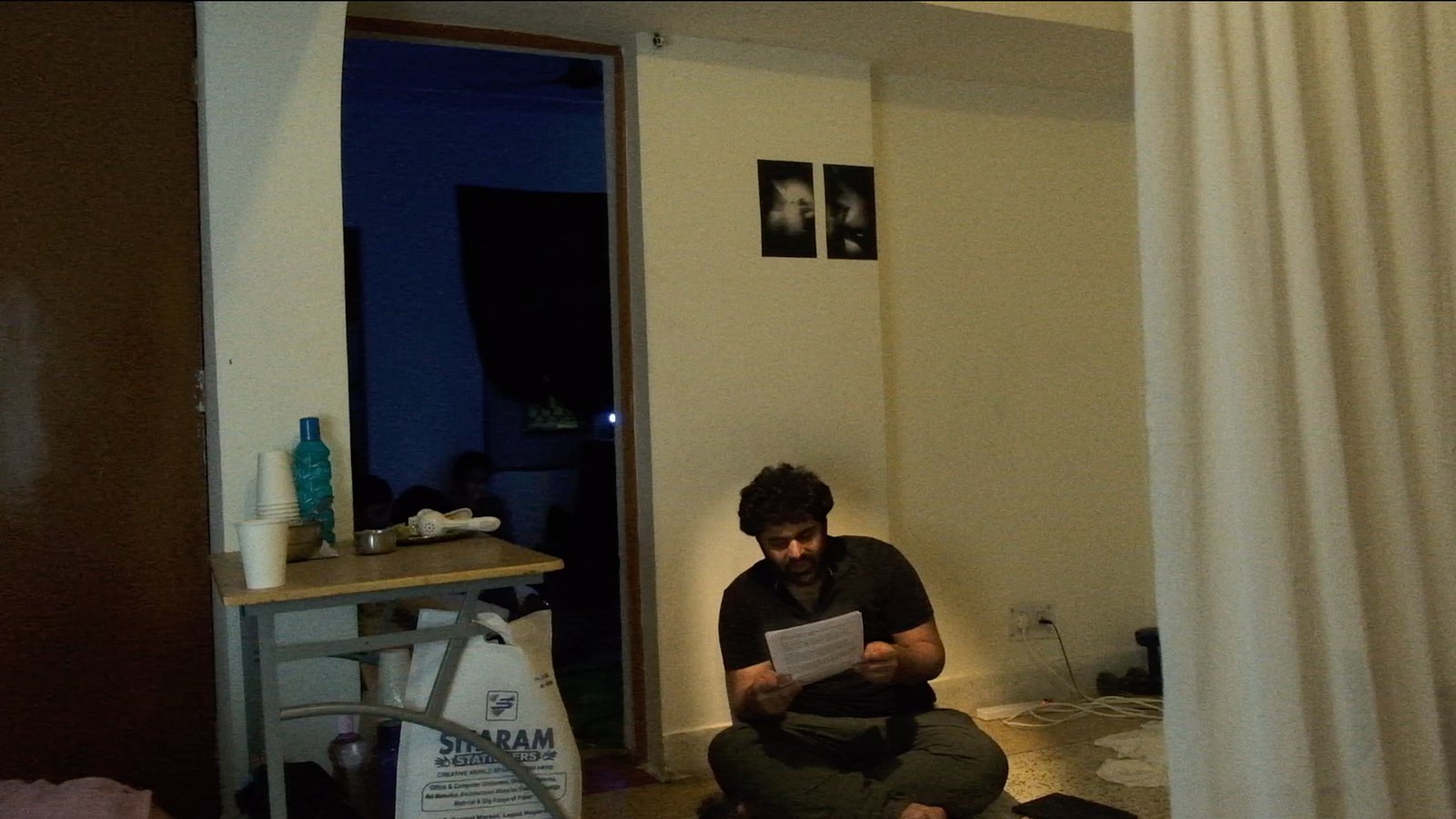
"दरमियानी पर्देदारियाँ और दस्तकें", Unfurling by Rahul Juneja
Queer Childhoods, a photo-performance by Mayank Agarwal
Pleating- Kaur X Nastrè X Tilottma
Mayank is an artist-researcher working with photography, video and image-making practices. He is a fellow at Sarai-CSDS, Delhi; and grantee for the 2024 Gender-Bender Festival by Sandbox Collective and Goethe Institut, Bangalore.
‘Queer Childhoods’ is a media, research and archival project where he is facilitating conversations and interviews with queer individuals about their childhood photographs. The project began as a collaboration between him and Gaurav Prateek through conversations over his own photographs.
Kaur Chimuk (they/yellow) is a trans-binary curatorial negotiator and artistic researcher focused on subversive curatorial methodologies and immersive performative representation. Based in Southeast Asia, they work extensively across India and Bangladesh while maintaining a base in Sweden with Meteor International. With over a decade of experience, they have collaborated with interdependent participatory platforms like the Kolkata International Performance Art Festival and Tracing A City. They are also on the curatorial board of Intrans, aka intersectional network for transglocal solidarity spanning Mexico, the UK, and India. Their durational collaborative initiative, A South-Asian Queer Pamphlet, bridges their curatorial curiosity with their gender transitions.
Rahul Juneja is an artist based between Karnal and New Delhi. He is interested in the expanding paradigms of image and language; closely examining colonial, historical and mythical frameworks and how they affect the generation, structuring and circulation of knowledge. Rahul detected Hekh in 2023.